UoG psychologist helps evaluate UK climate and nature campaign reaching 185,000 people
Dr Richard Clarke collaborated with the Centre for Climate Change…


At UoG sustainability is important to us, it’s one of our core values and we were the first universities to ditch our printed prospectus in favour of an online version.
As part of our UoG Career toolkit, students studying at UoG will have sustainability embedded into their course.
Our values underpin everything that we do.
Integrity
Ambition
Nurture
Curiosity
Sustainable
At UoG, a dedicated cross-departmental group brings together colleagues from across the institution to lead on sustainability.
Sustainability is as much about people as it is about structures or operations. We see sustainability as central to life, work and study in the university community. Across all departments, we are seeking to increase efficiencies, reduce negative impacts, and shape a better, healthier future for people and planet.
We seek to positively improve sustainability in the learning environment across our campuses, through responsible estates management, partnership working and public engagement. We also take opportunities to use our university sites to support learning for sustainability and use the campus as a living laboratory in the delivery of courses and research.
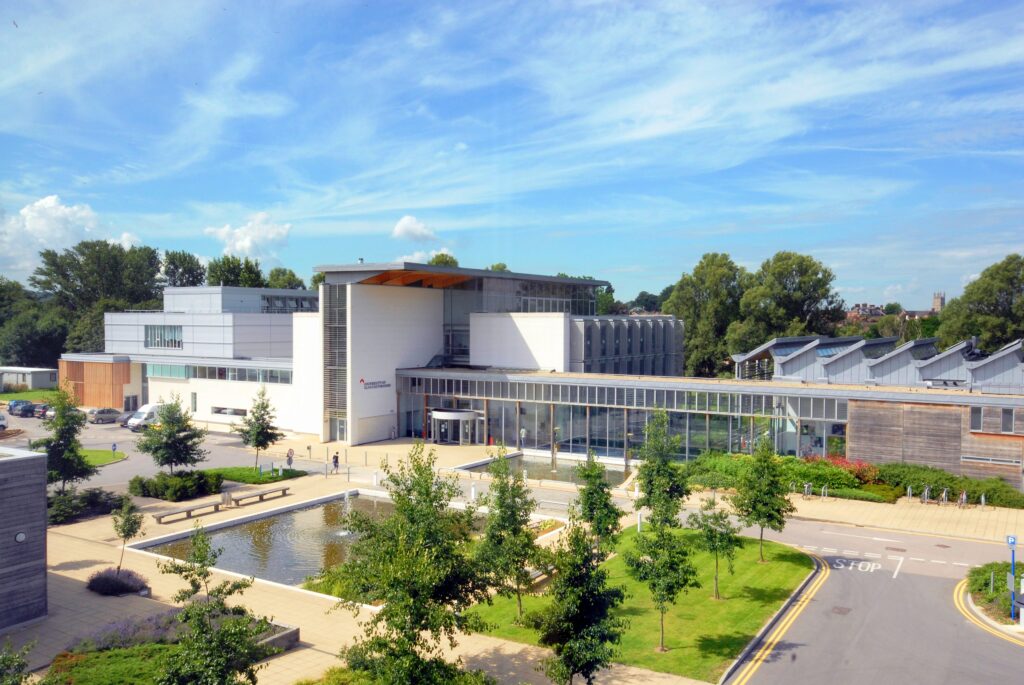



In 2019, we completed a rewilding project at our Oxstalls campus, part-funded by the European Regional Development Fund to improve campus biodiversity and reduce future flood risks.

Each year, our Estates team leave areas on our campuses to run wild.

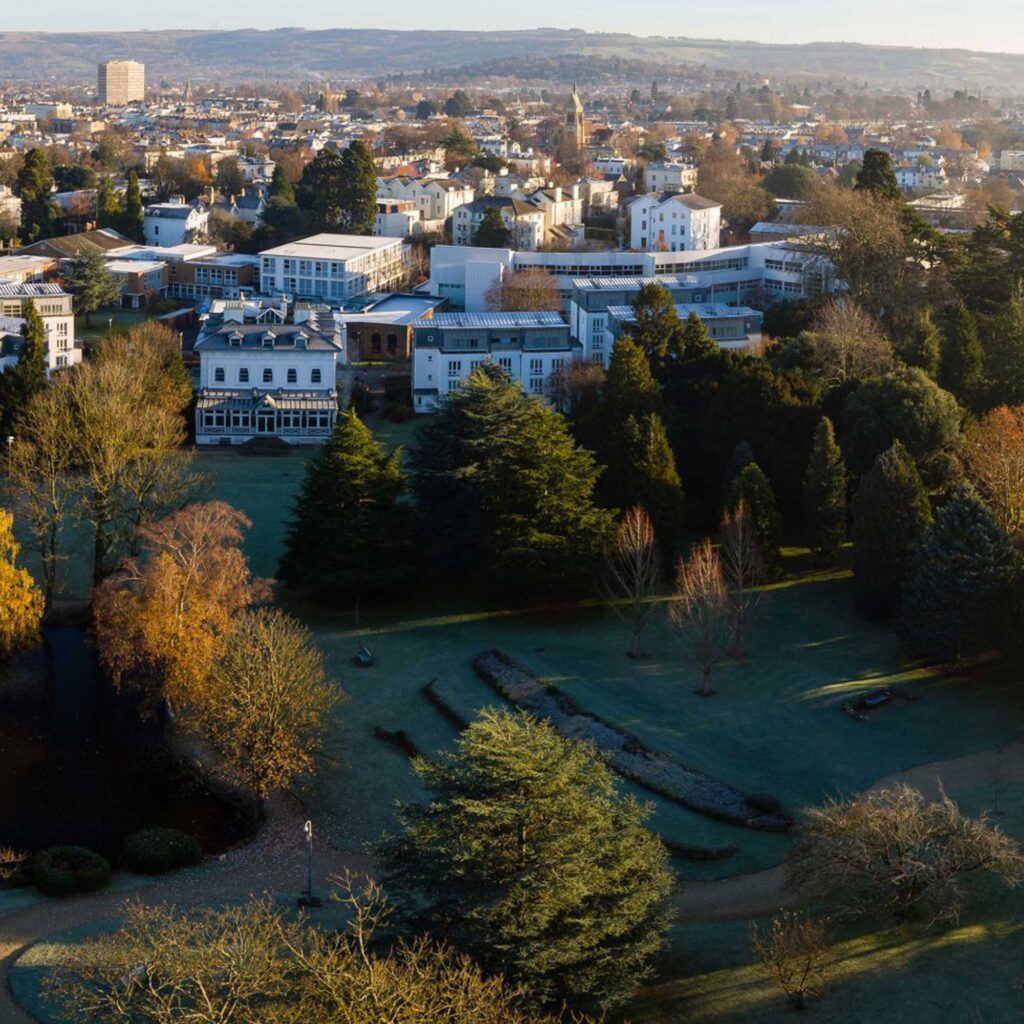
Park campus is used by students as a Living Laboratory for field work including biodiversity monitoring and action plans.
This covers the emissions that we produce directly, such as from gas and oil combustion for heat and hot water.
This covers the emissions that we produce indirectly such as through purchasing grid electricity.
This covers all other indirect emissions from activities such as transport, purchasing, waste and water use.
We need to drive action to minimise the most harmful levels of climate change, in line with scientific advice. The Paris Agreement aims to limit global warming to 2°C above pre-industrial levels or ideally 1.5°C. The UK committed to cut at least 55% in greenhouse gas emissions by 2030 compared to 1990 levels.
By aiming for Net Zero carbon, we are seeking a balance between the carbon we emit and the carbon we take out of the atmosphere. It means we drive down our emissions as much as possible – leaving the minimum remainder to offset.
The University seeks to manage its assets responsibly, so our financial decisions are critical for our sustainability impact. Our aim is to contribute to local economies and support social and global justice through ethical investment practices, developing sustainability in our supply chain and Fairtrade.
In 2022, University of Gloucestershire became one of the first universities in the UK to secure funding linked to our commitment to ESG goals, securing £29million in ESG linked loans that will contribute to supporting our ambitious City Campus development.
The University has held Fairtrade status since 2006 and, in 2022, we were accredited to the new Fairtrade standard. We achieved an additional one-star in recognition of our efforts to embed policies that ensure trade justice and ethical procurement and consumption are considered throughout our practices.
We take our fund management seriously and are committed to regular monitoring and updating of our ethical investment activities, in line with our institutional values and ethos. Our Ethical Investment Policy includes restrictions to the full scope of institutional investments and is signed off by Finance and General Purposes Committee (FGPC). Continuous improvements to this policy include:
Ethical Investment Policy
Sustainability is a key priority for the University and this extends to the sustainable investment of funds. To ensure that investments match the priorities and values of the University, an Ethical Investment Policy has been developed.
View our latest Ethical Investment Policy.
This Policy is intended to support our aims to invest in a better global future by delivering strong returns through involvement in companies which improve quality of life and provide environmental benefits.
We do not intentionally invest, directly or indirectly, in fossil fuel companies, armaments companies, tobacco companies, companies that fall below the recognised standard as identified by EIRIS or companies in violation of international law.
Renewable energy investments
Our investment portfolio includes holdings in green bonds and funds specifically directed at renewable energy and the transition to net zero. Current examples include:
Oversight of our investments
Our Finance and General Purposes Committee (F&GPC) is responsible for monitoring and advising Council on the financial health of the University, including the financial strategy, and risk management, budget setting, annual accounts, investment activity, and consideration of capital expenditure including estates and infrastructure activity. More details on F&GPC’s responsibilities and a list of the committee members can be found here.
The Ethical Investment Policy, which forms part of the Treasury Management Policy, is reviewed annually on behalf of Council, by the Finance and General Purposes Committee. The latest review was conducted in June 2026.
Members of the University community have an opportunity to engage with the Ethical Investment Policy and any comments or queries should be sent through to [email protected].
Our catering operation is a critical – and highly visible – statement about our commitment to sustainability. Food brings together issues such as healthy eating, supply chain integrity, waste and packaging, cultural diversity, fair trade and carbon reduction.



We are committed to delivering our policy requirements on healthy, seasonal and responsibly sourced food, as well as good environmental management in our refectories and kitchens.
Our sustainable food policy sets targets on:
Discover more about Catering at the University
Since 2024, we have had a 3 star Food Made Good accreditation.

We are committed to being a community with a global outlook that is advancing diversity, promoting intercultural learning and pursuing equity for all. Our commitments are set out in our Equity, Diversity and Inclusion Strategy which aims to make equality of opportunity a reality for all students and staff – and to develop an inclusive culture, free from discrimination related to gender, disability, sexual orientation and other protected characteristics.
Our strategic equity, diversity and inclusion goals are:
Discover more about Equity, Diversity and Inclusion at University of Gloucestershire.
This project seeks to develop our course experiences to advance cultural and ethnic diversity as well as global perspective through teaching practice. It draws on the experiences of our BAME staff and student network and is supported by our LIFT programme for transformative learning that can deliver more sustainable futures.


We are working to reduce our gender pay gap to understand and improve the difference between the average salary of a man and the average salary of a woman working at the University.
As a multi-campus university spanning sites in Cheltenham and Gloucester, helping students and staff to make smarter travel, low carbon choices is important to:
Cheltenham and Gloucester are beautiful places to explore and commuting by foot, bike, scooter or bus are great ways to discover the local area and enjoy the benefits of smart travel.
We promote travelling between our campuses in sustainable ways including walking, cycling and e-scooters.
Students can buy secure bicycle locks though the University’s online store.
Staff can buy a bike or e-bike and cycle kit tax-free using salary sacrifice through HR.
Voi operates in Cheltenham and Gloucester with parking locations on all campuses.
Shower facilities: we have shower facilities on each of our campuses for staff to use after an active commute.
Our campuses are well located with good transport links.
Stagecoach offer bus passes and deals for part and full academic year options. These are available from their website or through the Stagecoach app which also provides live bus times.
National services flow regularly to Cheltenham Spa and Gloucester train stations and bus services can connect stations to all UOG campuses.
For staff and students who do need to travel by car, we support:
Reduced price campus parking permits are available for car sharers and we have a staff car share scheme to encourage lift sharing.
We support electric vehicle usage with charging points at Oxstalls, Park, FCH campuses.
We use maintenance vehicles which run on electricity at our Park and Oxstalls sites, and our IT department use an electric van.
View our sustainable travel plan.
We are shifting our educational and office systems towards agile working as the reduced travel helps towards our carbon reduction goals.

Technology enables our learning experiences, optimises our working practices and can help staff and students to travel less between campuses and to connect more easily. It is also one of the fastest growing areas of energy consumption and carbon emissions in the university sector, so bringing sustainability into computing equipment and services is an important future agenda for us.
Our Digital Strategy highlights lower carbon digital solutions and takes account of:
Our IT and Library teams support the sustainability agenda by:
Managing our waste and water are important sustainability priorities to improve our environmental performance and reduce costs in running our estate. We have put measures in place to minimise our impact and to engage with people in ways that contribute to shifting thinking around waste and supporting the circular economy.
We are an institution that no longer sends waste to landfill via our contractor.
Our targets in our Sustainability Strategy 2022-2027 are:
23%
Reduce waste arising
by 23%
60%
Increase recycling
rate to 60%
12%
Reduce water
consumption by 12%
We have reduced our water consumption by over 30% since 2022, surpassing the goal of 12% set out in our 2022-27 Sustainability Strategy.
We are now pushing beyond this, introducing smart meters on all of our water supplies and aiming to eliminate leaks and constant flows across the estate by 2027.
2024/25 total water consumption = 30,575 cubic metres vs.
2021/22 total water consumption = 44,143 cubic metres)
Source data: Estates Management Record
In 2017/18 we successfully trialled the removal of disposable cups from our refectories resulting in 4,610 cups being eliminated from our waste stream in just one summer. This scheme was rolled out permanently from September 2018 with re-usable cups available for purchase from the SU or refectories. Alternatively, we have mugs available for anyone who does not have their own.
In 2021, the refectories introduced charges for single-use items to further encourage continued behaviour change.
We work with British Heart Foundation’s Pack for Good initiative, creating value for the charity through donated goods as students move out of halls of residence.
Normally this averages around 1,250 bags of goods annually.
Across the globe people are making links between wellbeing, productivity and our ability to move forward on sustainability. We all have professional responsibilities in sustainability and with this comes the potential for greater creativity and success in our organisations.
We aim to encourage staff to understand the need for sustainability in their job roles as a way to achieve wider change and to support them to increase their positive impact as professionals and citizens. Supported by our People Strategy, the University:
Wellbeing is critical for sustainability – the importance of wellbeing as one of the keys to sustainability is the reason health and wellbeing is one of the UN global goals.
The OECD 2020 analysis of wellbeing indicators shows how natural capital and environmental protection is interlinked with social and economic aspects of wellbeing. This recognition is growing at policy level – the 2015 Wellbeing of Future Generations Act in Wales recognises how the wellbeing of people and communities critically depends upon the health of the planet.
Priorities in this area include smart travel and our carbon emissions reduction work, which is an important contribution to improving air quality and wider public health.
There are opportunities for staff, students and local people to get involved in gardening activities at our campuses:
The University has held Fairtrade status since 2006 and since then Fairtrade has been an important part of how we demonstrate ethical consumption and social justice.
In 2022 we were successfully accredited to the new Fairtrade standard, achieving an additional one-star in recognition of our efforts to embed policies that ensure trade justice and ethical procurement and consumption are considered throughout our practices.
Our Fairtrade policy reflects the 5 goals of the Fairtrade Foundation: